Recipes, Benefits, and Why It Makes the Perfect Gift
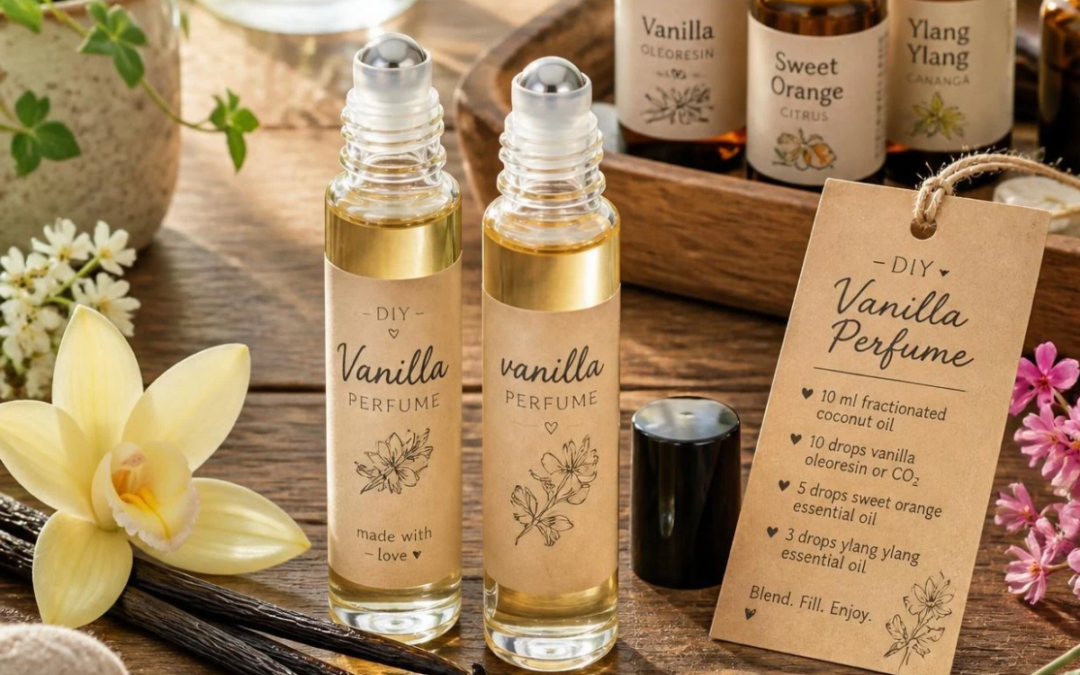
DIY Vanilla Perfume: 2 Simple Vanilla Perfume Recipes
Vanilla perfume is one of those scents that never seems to go out of style. It’s warm, sweet, comforting, and incredibly easy to pair with other scents.
I’ve been making and experimenting with essential oil blends for years, and one of my favorite things about creating your own perfume is that you don’t have to settle for whatever happens to be sitting on a department store shelf.
You can make a small batch, choose your own ingredients, experiment with different scents, and create something that actually smells like you.
And if you love vanilla, you’re in luck. Vanilla makes a wonderful base for all kinds of perfume blends—from light and citrusy scents for spring and summer to warm, woodsy blends for fall and winter.
Today we’re keeping things simple with roller-bottle perfumes that you can make with a carrier oil and aromatic ingredients.
Let’s make some perfume!
Why Make Your Own Vanilla Perfume?
There are plenty of reasons to try making your own perfume, but here are a few of my favorites.
You Control the Ingredients
When you make your own perfume, you get to choose what goes into it.
I like knowing exactly what I’m putting into a product that I’m going to use on my skin. It also gives you the opportunity to choose ingredients that fit your own preferences.
You Can Create a Scent That’s Uniquely Yours
This is probably my favorite part.
Vanilla doesn’t have to mean smelling like a cupcake. Pair it with citrus and it becomes bright and fresh. Add florals and it becomes soft and feminine. Combine it with woods and spices and you’ve got something completely different.
Once you start experimenting, the combinations are practically endless.
You Can Make Scents for Different Seasons
Some perfume blends just feel like summer.
Others practically demand a cozy sweater.
A lighter vanilla blend with citrus or floral notes can be lovely for spring and summer, while vanilla paired with woods and warm spices makes a beautiful fall and winter perfume.
Why have just one vanilla perfume when you can have a seasonal collection?
You Can Make a Small Batch
You don’t need to make a giant bottle of perfume.
Roller bottles are perfect for experimenting because you can make a small amount, try a new combination, and adjust your next batch based on what you like.
It’s a Thoughtful Handmade Gift
Homemade perfume makes a lovely gift because you can customize the scent for the person you’re making it for.
Add a pretty label, tuck the roller bottle into a small gift box, and you’ve got a simple handmade gift that feels much more personal than something grabbed at the last minute.
And Honestly… It’s Fun
There’s something pretty satisfying about blending a scent and realizing:
“Hey, I made that.”
If you enjoy essential oils and DIY projects, making your own perfume is a fun little rabbit hole to fall into.
Choosing Your Ingredients
Before we get to the recipes, let’s talk about a few of the ingredients you’ll need.
What Kind of Vanilla Should You Use?
One important thing to know is that vanilla isn’t generally an essential oil in the same way lavender, peppermint, or sweet orange are.
You’ll find vanilla in several forms, including vanilla oleoresin, vanilla absolute, and vanilla CO₂ extracts.
They can vary in consistency, aroma, and how easily they blend into different formulations.
For an oil-based roller perfume, look for a vanilla aromatic ingredient specifically intended for this type of use and follow the supplier’s recommendations.
I particularly like sourcing my aromatherapy ingredients from Aromatics International because they provide detailed information about their individual ingredients and how they can be used.
Tip: Vanilla ingredients can be thick and may behave differently from the essential oils you’re used to working with. A little patience—and sometimes warming the bottle gently between your hands—can help when working with thicker extracts.
Choosing a Carrier Oil for Your Vanilla Perfume
For a roller-bottle perfume, your carrier oil isn’t just there to dilute the aromatic ingredients. The carrier itself can have an effect on how the finished perfume smells and feels on your skin.
Here are a few popular options.
Jojoba Oil
Jojoba is one of my favorite choices for a roller perfume.
It has a very mild, natural scent and a silky feel on the skin. Because its aroma is relatively subtle, it works well when you want your vanilla and essential oils to be the stars of the show.
Fractionated Coconut Oil
If you want your carrier oil to stay as neutral as possible, fractionated coconut oil is a great option.
It is lightweight, has very little noticeable scent, and won’t compete much with the aroma you’re creating.
This makes it particularly nice for delicate perfume blends where you want to smell the vanilla and other aromatic ingredients without adding another noticeable scent.
Sweet Almond Oil
Sweet almond oil has a mild, slightly nutty aroma and a lovely skin feel.
That subtle scent can be pleasant in a warm or cozy perfume blend, although it may be more noticeable than a very neutral carrier such as fractionated coconut oil.
If you have a nut allergy, choose a different carrier oil.
Apricot Kernel Oil
Apricot kernel oil is another lightweight carrier that can work nicely in body-care applications.
It has a mild aroma, so it generally won’t overpower a perfume blend, but it may contribute a little more character than a completely scent-neutral carrier.
Which Carrier Oil Should You Choose?
Honestly, there’s no reason to overthink this.
If you want a very neutral base, try fractionated coconut oil.
If you want something with a silky feel and a very subtle natural aroma, try jojoba.
If you’re curious about experimenting, try a small batch with different carriers and see which one you prefer.
That’s part of the fun of making your own perfume!
🌸 Spring & Summer Vanilla Perfume
For spring and summer, I like vanilla paired with lighter, brighter notes.
This blend is sweet without being overly heavy, with citrus and floral notes helping to keep the vanilla feeling fresh.
Vanilla Citrus & Lavender Roller Perfume
You’ll Need:
- 10 mL glass roller bottle
- 2 teaspoons jojoba oil or fractionated coconut oil
- 4 drops vanilla aromatic ingredient
- 3 drops lavender essential oil
- 2 drops sweet orange essential oil
- 1 drop bergamot essential oil
How to Make It:
- Add the vanilla aromatic ingredient and essential oils to your roller bottle.
- Fill the bottle with your carrier oil, leaving a little room at the top for the roller insert.
- Insert the roller top and cap.
- Gently roll or shake the bottle to combine the ingredients.
- Let the blend rest for a day or two before deciding what you think of the finished scent.
Give it another sniff after it has had some time to settle. Aromatic blends can smell different after they’ve had a little time to mingle.
Want It More Citrus-y?
Add a little more sweet orange.
Want More Vanilla?
Add another drop or two of your vanilla ingredient.
Want It More Floral?
Try adding another drop of lavender or experimenting with another floral aromatic.
Just remember that more isn’t always better when it comes to essential oils. Make small adjustments and keep track of what you add.
🍂 Fall & Winter Vanilla Perfume
When the weather gets cooler, I’m ready for warmer, deeper scents.
Vanilla pairs beautifully with woods, resins, and spices, making it a natural fit for fall and winter.
Warm Vanilla Woods Roller Perfume
You’ll Need:
- 10 mL glass roller bottle
- 2 teaspoons jojoba oil or fractionated coconut oil
- 4 drops vanilla aromatic ingredient
- 2 drops sandalwood essential oil
- 2 drops frankincense essential oil
- 1 drop cedarwood essential oil
- 1 drop sweet orange essential oil
How to Make It:
- Add the vanilla and essential oils to your roller bottle.
- Fill with your carrier oil.
- Insert the roller top and cap.
- Gently roll the bottle between your hands to combine.
- Let the perfume rest for a day or two before deciding whether you’d like to make any adjustments.
The result is a warm, slightly sweet, woodsy vanilla perfume that feels right at home during the cooler months.
And if you happen to be someone who thinks everything smells better with a little frankincense…
Well, I won’t argue with you.
How to Customize Your Vanilla Perfume
Once you’ve made one or two vanilla perfumes, you’ll probably start thinking about all the other combinations you could try.
Here are some ideas to get you started.
For a Fresh Vanilla Scent
Try pairing vanilla with:
For a Floral Vanilla Scent
Try:
For a Woodsy Vanilla Scent
Try:
For a Warm & Spicy Vanilla Scent
Try:
A note about spices: Some essential oils, particularly certain spice oils, can be irritating to the skin and have specific dermal-use considerations. Don’t simply add a bunch of cinnamon or clove to a perfume because you want it to smell “spicy.” Check the supplier’s recommended skin-use guidelines and keep your dilution appropriate.
Tips for Making Your DIY Perfume
Keep Notes
If you’re experimenting, write down exactly what you put into each bottle.
Trust me on this one.
“That one that smelled really good” isn’t a very useful recipe.
Keep track of the oils, number of drops, carrier oil, and date you made it.
Let Your Perfume Rest
Give your blend a little time to settle before deciding whether you love it.
You may find that the scent changes as the aromatic ingredients mingle together.
Start Small
You can always add another drop.
You can’t easily remove the drop you already added.
When experimenting with perfume, small adjustments are your friend.
Do a Patch Test
Essential oils and other aromatic ingredients can cause skin irritation or sensitization in some people.
Before using a new perfume blend all over your skin, test a small amount first and discontinue use if irritation occurs.
Always follow the supplier’s safety and dilution recommendations for the specific ingredients you’re using.
DIY Vanilla Perfume Makes a Great Handmade Gift
I love DIY projects that can double as gifts, and perfume is a perfect example.
You can make a custom scent for a friend, daughter, sister, coworker, or anyone who enjoys natural fragrance.
A few simple ideas:
Use a pretty glass roller bottle.
A 10 mL roller bottle makes a convenient size for a handmade perfume.
Create a custom label.
Give your perfume a name based on the scent or the person you’re making it for.
Make a seasonal gift set.
Pair a spring/summer vanilla perfume with a fall/winter version and you’ve got a little vanilla perfume collection.
Add a handwritten recipe card.
Especially if you’re giving the perfume to another DIY enthusiast, include the ingredients so they know exactly what you made.
Create a Life That Naturally Makes Scents 🌿
If you’ve been wanting to make a few simple changes toward a more natural lifestyle, you don’t have to change everything overnight.
That’s one of the things I love about DIY aromatherapy—you can start small.
Make a perfume.
Try a room spray.
Blend something for your diffuser.
Make a simple body oil.
Experiment with what works for you.
Aromatics International has a customizable Natural Living Makeover Bundle with many of the essential oils, carrier oils, hydrosols, bases, and supplies used in their natural-living projects.
I especially like the idea behind this bundle because you can choose what you actually need instead of ending up with a giant box of things you’ll never use.
Ready to create a life that naturally makes scents?
Check out the Natural Living Makeover Bundle →
Disclosure: Some links in this post are affiliate links, which means I may earn a commission if you make a purchase through my link, at no additional cost to you.
Frequently Asked Questions
How long does homemade vanilla perfume last?
The shelf life will depend on the ingredients you use, the type of formulation, and how the perfume is stored.
Because we’re making an oil-based perfume, keep your roller bottle tightly closed and store it away from excessive heat, light, and moisture.
Rather than assuming every homemade perfume has a specific shelf life, pay attention to the shelf life and storage recommendations for the carrier oil and aromatic ingredients you’re using.
Can I use a different carrier oil?
Absolutely.
Jojoba and fractionated coconut oil are two of my favorites, but other carrier oils can also work.
Keep in mind that carrier oils have their own textures and aromas, so choosing a different one can subtly change the finished perfume.
Can I make vanilla perfume without essential oils?
Yes. Your perfume doesn’t have to contain essential oils just because you’re making it at home.
Vanilla extracts, absolutes, and other aromatic ingredients can be used depending on the type of perfume you’re making and the supplier’s recommended uses.
Can I use vanilla extract from my kitchen?
I wouldn’t use ordinary baking vanilla extract as a perfume ingredient.
Kitchen vanilla extract is formulated for cooking, not for use as a leave-on fragrance product. Instead, choose a vanilla aromatic ingredient intended for cosmetic or perfumery use.
Can I use these recipes in a spray bottle?
These recipes are specifically designed as oil-based roller perfumes.
If you’d like to make a vanilla perfume spray, that’s a different formulation and requires different ingredients and considerations.
In fact, that’s a project for another day. 😉
Final Thoughts
Making your own vanilla perfume is a simple way to experiment with natural fragrance without needing a giant collection of ingredients or complicated equipment.
Start with vanilla and a carrier oil you like. Add a couple of complementary scents, make a small batch, and see what happens.
Maybe you’ll end up with a beautiful spring perfume.
Maybe you’ll discover that vanilla and sandalwood are your new favorite combination.
Or maybe you’ll make one that smells absolutely nothing like you imagined.
That’s okay, too.
That’s how you learn what you like.
And before you know it, you’ll be creating your own signature scents.
Have fun creating a life that naturally makes scents! 🌿
A Note About Safety
This post is for educational and informational purposes. Essential oils and other aromatic ingredients are highly concentrated materials and should be used appropriately.
Always follow the supplier’s recommended dilution, dermal-use, and safety guidelines for the specific ingredients you’re using. Perform a patch test before using a new perfume blend, and discontinue use if irritation occurs.
If you are pregnant, nursing, have a medical condition, take medications, or are making products for children, consult an appropriately qualified healthcare professional before using essential oils.
Disclosure
Amazon Affiliate Disclosure: As an Amazon Associate I earn from qualifying purchases.
Some links in this post are affiliate links, which means I may earn a commission if you make a purchase through my link, at no additional cost to you.
